


Hidden Historic Istanbul – Palaces, Hans & Passages Most Tourists Miss
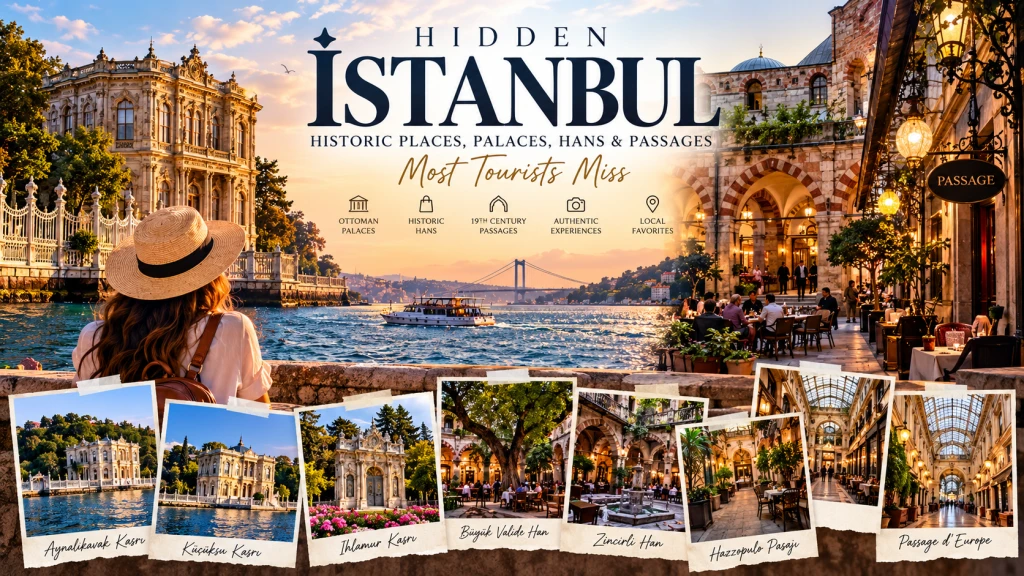
Hidden Historic Istanbul – Palaces, Hans & Passages Most Tourists Miss
When most travelers imagine historic Istanbul, the same places usually come to mind: Hagia Sophia, the Blue Mosque, Topkapı Palace, the Grand Bazaar and Dolmabahçe Palace.
They absolutely deserve to be seen.
But they are only the beginning.
Istanbul was the capital of empires for centuries, and its history is far too rich to be understood through five or six famous monuments. Ottoman pavilions are hidden beside busy neighborhoods. Centuries-old trading hans continue to operate behind the Grand Bazaar. Elegant passages remain only a few steps away from İstiklal Avenue, yet thousands of people walk past their entrances every day without realizing what is inside.
Many international visitors simply do not know these places exist.
That is exactly why we recommend making room for them.
You should not leave Istanbul thinking that the city consists only of its most photographed landmarks. Sometimes the places that explain Istanbul best are the ones with no enormous queue outside.
This guide takes you into that quieter side of the city.
1. Aynalıkavak Kasrı – A Forgotten Ottoman Palace on the Golden Horn
📍 Location: Keçeci Piri, Donanma Cd., 34440 Beyoğlu, Istanbul
Open Aynalıkavak Kasrı in Google Maps
Aynalıkavak Kasrı
4,5Müze
Most visitors staying around Sultanahmet or Taksim have probably never heard of Aynalıkavak Kasrı.
That is surprising, because the building represents a part of Ottoman Istanbul that has almost completely disappeared.
Aynalıkavak is the only surviving structure from the former Tersane Palace complex, once one of the great Ottoman palace complexes around the Golden Horn. The area was associated with imperial gardens and waterfront life for centuries, and the pavilion eventually took the form visitors see today through several Ottoman periods.
What makes Aynalıkavak different is its atmosphere.
There is no enormous ceremonial square, no massive tourist crowd and no feeling that you must rush from room to room.
Instead, you encounter a smaller and more intimate piece of imperial Istanbul.
The Golden Horn setting also makes the visit particularly interesting because it helps you understand that Ottoman palace life was not limited to Topkapı and Dolmabahçe.
Why we recommend it
Visit Aynalıkavak if you are interested in:
- Ottoman architecture
- Imperial Istanbul
- Quiet historical locations
- The Golden Horn
- Places outside standard tourist itineraries
Suggested visit: 45–60 minutes.
Combine it with: Rahmi M. Koç Museum, Hasköy and the Golden Horn waterfront.
Our local tip
Don't arrive expecting another Dolmabahçe Palace.
That is exactly why you should come.
Aynalıkavak is valuable because it shows a quieter and more personal side of Ottoman palace culture.
2. Küçüksu Kasrı – A Palace-Like Pavilion Directly on the Bosphorus
📍 Location: Göksu, Küçüksu Cd., 34810 Beykoz, Istanbul
Open Küçüksu Kasrı in Google Maps
Küçüksu Kasrı (Milli Saraylar)
4,6Müze
Küçüksu Kasrı occupies one of those locations that makes you wonder why it isn't included in more first-time Istanbul itineraries.
It sits beside the Bosphorus between the Göksu and Küçüksu streams, in an area that had already become an important imperial recreation ground during the Ottoman period. The National Palaces administration traces palace use of the area back centuries, with earlier wooden structures preceding the pavilion associated with the site today.
The setting is the real magic.
You have the Bosphorus directly in front of you, Anadolu Hisarı nearby and some of the most attractive sections of Istanbul's Asian shoreline surrounding the pavilion.
This is the type of Istanbul experience where architecture and geography work together.
Why we recommend it
Küçüksu is particularly good for travelers who have already seen central Istanbul and want to explore the Bosphorus more deeply.
You get:
- Ottoman architecture
- Bosphorus scenery
- A calmer environment
- Easy access to Anadolu Hisarı
- Excellent photography opportunities
Suggested visit: Around 1 hour.
Combine it with: Anadolu Hisarı, Göksu, Kanlıca or a longer Asian-side Bosphorus route.
Our local tip
Don't simply visit the building and leave.
Spend some time by the water.
Part of the experience is understanding why Ottoman rulers chose this stretch of the Bosphorus as a place to escape the dense historic city.
3. Ihlamur Kasrı – An Ottoman Retreat Hidden Between Beşiktaş and Nişantaşı
📍 Location: Türkali Mah., Hakkı Yeten Cad. No:1, Beşiktaş, Istanbul
Open Ihlamur Kasrı in Google Maps
Ihlamur Kasrı
4,6Müze
Thousands of travelers visit Beşiktaş and Nişantaşı.
Far fewer realize that an Ottoman imperial retreat sits between them.
The Ihlamur Valley was historically a green recreation area, and during the reign of Sultan Abdülmecid the site developed into the pavilion complex visitors can experience today. The complex includes the Merasim Köşkü, associated with ceremonial use, and the Maiyet Köşkü, associated with the Sultan's entourage.
The ornate exterior of the Merasim Köşkü is particularly striking.
Its decoration reflects the Western-influenced architectural tastes that became increasingly visible in 19th-century Ottoman palace design.
Yet because Ihlamur is considerably smaller than Istanbul's major palaces, the experience feels less exhausting and more intimate.
Why we recommend it
It is perfect when you want history without dedicating half a day to a huge museum complex.
Suggested visit: 45–75 minutes.
Combine it with: Beşiktaş, Nişantaşı, Yıldız Park or Dolmabahçe.
The official National Palaces information currently lists Monday as the regular closed day; schedules can change, so check again before visiting.
Our local tip
Ihlamur is especially useful for visitors with a busy itinerary.
You can see a genuine piece of Ottoman imperial architecture without leaving central Istanbul or spending several hours in a queue.
From Palaces to Hans: Enter Istanbul's Old Commercial World
Imperial buildings tell only one half of Istanbul's history.
To understand the city properly, you also need to understand trade.
For centuries Istanbul was one of the great commercial crossroads between Europe, Asia, the Mediterranean and the Black Sea.
The historic han was central to that world.
Merchants could trade, store goods, work and, in some cases, stay within these large courtyard complexes.
Some survived.
And remarkably, some still contain workshops and businesses today.
4. Büyük Valide Han – Walk Into the Commercial Istanbul of the 17th Century
📍 Location: Mercan, Çakmakçılar Yokuşu No:33, Fatih, Istanbul
Open Büyük Valide Han in Google Maps
Büyük Valide Han
4,3Turistik Yer
This is one of the places where Istanbul stops feeling like a museum and starts feeling like a city that has simply continued living inside its own history.
Büyük Valide Han was built in the 17th century by Kösem Sultan, one of the most influential women in Ottoman history. Located in the old commercial district around Mahmutpaşa, it became an important part of Istanbul's trading network.
Walk through its entrance and the atmosphere changes.
Stone walls, courtyards, workshops, warehouses and small businesses replace the polished shopfronts of the more tourist-oriented streets nearby.
That contrast is precisely what makes it interesting.
Why we recommend it
Don't come here expecting a restored palace.
Come because it feels like a fragment of historic commercial Istanbul that is still functioning.
It gives context to the Grand Bazaar.
The bazaar was never an isolated attraction. It was surrounded by an enormous economic ecosystem of hans, workshops, storage spaces and merchants.
Suggested visit: 30–45 minutes.
Combine it with: Grand Bazaar, Mahmutpaşa, Süleymaniye Mosque and Spice Bazaar.
Important note
Historic hans remain working environments and parts of buildings may be private or restricted.
Respect workshops, businesses and access restrictions. In particular, don't attempt to enter roofs or closed areas just to recreate social-media photographs.
Our local tip
Visit the Grand Bazaar first, then walk toward Büyük Valide Han.
The transition helps you understand how much larger Ottoman commercial Istanbul was than the bazaar tourists usually see.
5. Zincirli Han – A Quiet Courtyard Hidden Inside the Grand Bazaar
📍 Location: Grand Bazaar / Beyazıt, Fatih, Istanbul
Open Zincirli Han in Google Maps
Nakşiler Zincirli Han
4,7Kuyumcu
The Grand Bazaar can feel overwhelming.
Thousands of people move through its streets, sellers call from their shops and every turn seems to lead to another corridor.
Then you step into Zincirli Han.
The atmosphere suddenly changes.
The historic courtyard, traditional architecture and large tree at its center create a much calmer environment than the surrounding bazaar streets.
Visit Istanbul includes Zincirli Han among the city's hidden historic treasures and highlights its role in Istanbul's old trading culture
Why we recommend it
This isn't necessarily somewhere you need two hours.
That's part of the charm.
It is a small discovery inside a much bigger attraction.
Walk into the Grand Bazaar, explore its famous streets and then deliberately search for the han.
Suddenly the bazaar becomes more than shopping.
It becomes architecture.
Best for
- Photography
- Architecture
- Grand Bazaar exploration
- Travelers interested in Ottoman commerce
- Visitors who enjoy finding hidden courtyards
Suggested visit: 15–30 minutes.
Our local tip
The Grand Bazaar becomes far more interesting when you stop treating it as one building.
Look for hans, gates, courtyards and workshops. Zincirli Han is a perfect introduction to doing that.
Then Cross Into 19th-Century Pera
Historic Istanbul isn't only Ottoman palaces and the Grand Bazaar.
Move across the Golden Horn to Beyoğlu and the architecture changes dramatically.
This was the cosmopolitan Istanbul of embassies, theaters, European merchants, publishers, cafés and elaborate commercial passages.
İstiklal Avenue remains crowded from morning until late at night.
But some of its most interesting spaces are hiding behind narrow entrances.
6. Hazzopulo Pasajı – Step Off İstiklal and Into Another Istanbul
📍 Location: İstiklal Caddesi No:116, Beyoğlu, Istanbul
Open Hazzopulo Pasajı in Google Maps
Hazzopulo is exactly the kind of place many tourists accidentally walk past.
Its entrance sits off İstiklal Avenue, one of the busiest pedestrian streets in the country.
Walk through and suddenly you find a historic passage and courtyard rather than another enormous shopping store.
The passage dates to the late 19th century and historically housed trades including tailors, hatters and bookshops. Today it contains small businesses and cafés while retaining the feeling of an old Beyoğlu arcade.
Local Beyoğlu information places it at İstiklal Caddesi No.116.
Why we recommend it
Hazzopulo demonstrates one of the secrets of exploring Istanbul:
Sometimes you need to leave the main street without actually leaving the main street.
İstiklal is full of historic layers that remain invisible if you only walk straight from Taksim to Galata.
Enter the passages.
Look through the courtyards.
Notice the upper floors.
That is when Beyoğlu starts becoming much more interesting.
Suggested visit: 20–40 minutes.
Combine it with: İstiklal Avenue, Galatasaray, Pera Museum, Çiçek Pasajı and Asmalımescit.
Our local tip
Come here when you need a short break from İstiklal.
Sit down, have Turkish tea and then continue exploring Beyoğlu.
You don't need every historical stop in Istanbul to become a major expedition.
7. Passage d'Europe – Avrupa Pasajı / Aynalı Pasaj
📍 Location: Meşrutiyet Cad. No:8, Beyoğlu, Istanbul
Open Passage d'Europe in Google Maps
This may be one of the best examples of a place that thousands of people can stand near without really noticing.
Passage d'Europe, also known as Avrupa Pasajı or Aynalı Pasaj, connects Meşrutiyet Avenue and Sahne Street in Beyoğlu.
The passage was constructed in 1874 after the great Beyoğlu fire of 1870. Visit Istanbul describes it as a 56-meter-long neoclassical arcade containing 22 shops, with architectural features including upper-level statues, glass elements and chandeliers.
This isn't Ottoman Istanbul in the same visual language as Topkapı.
It represents something equally important:
the cosmopolitan Pera of the 19th century.
Why we recommend it
It helps explain how diverse historic Istanbul actually was.
The city wasn't built in one period, by one community or in one architectural style.
Palaces, mosques, churches, synagogues, hans, European arcades, embassies and commercial buildings grew alongside one another.
Passage d'Europe allows you to see another layer of that story.
Suggested visit: 15–30 minutes.
Combine it with: Hazzopulo Pasajı, Çiçek Pasajı, Beyoğlu Fish Market, Pera and Galata.
Our local tip
Don't rush through.
Look upward.
Some of the most interesting architecture in Beyoğlu is above the shop signs and eye level.
How to Visit These Places Without Wasting a Day in Traffic
Don't try to visit all seven in one random order.
Istanbul is enormous.
Instead, divide them into three logical routes.
Route 1 – Historic Peninsula
Grand Bazaar → Zincirli Han → Büyük Valide Han → Süleymaniye
This can comfortably form a half-day historic walking route.
Route 2 – Beyoğlu & Golden Horn
Aynalıkavak Kasrı → Beyoğlu → Passage d'Europe → Hazzopulo Pasajı
This combines Ottoman waterfront history with cosmopolitan Pera.
Route 3 – Bosphorus Palaces
Ihlamur Kasrı → Bosphorus → Küçüksu Kasrı → Anadolu Hisarı / Kanlıca
This route requires more transportation but offers a completely different side of Istanbul.
Why We Think You Should Visit These Places
There is a reason these places are quieter than Hagia Sophia or Topkapı Palace.
Many visitors simply don't know about them.
International travel itineraries tend to repeat the same ten landmarks. When travelers only have two or three days, that is understandable.
But Istanbul deserves more time.
The city inherited an extraordinary concentration of architecture, trade, religion, imperial culture and neighborhood life from centuries of history.
You shouldn't say you have completely discovered Istanbul after seeing only its most popular attractions.
Those attractions are important, but they are only the most visible chapter.
Aynalıkavak tells another story.
Küçüksu tells another.
The old hans around the Grand Bazaar tell another.
The passages of Beyoğlu tell another.
Put these stories together and Istanbul begins to make much more sense.
Our recommendation is simple:
See the famous Istanbul first. Then start looking behind it.
Walk through the narrow entrance.
Enter the courtyard.
Take the side street.
Visit the small pavilion tourists forgot to add to their itinerary.
Because the real richness of Istanbul is not concentrated in one square.
It is scattered across the entire city.
And discovering those places may become the part of Istanbul you remember most.
Useful note for visitors
Historic-site opening hours, ticket conditions and restoration/access rules can change. For the National Palaces locations such as Aynalıkavak, Küçüksu and Ihlamur, check the official National Palaces information shortly before visiting.
Our partners