
Basilica Cistern and Istanbul's Underground Cisterns: Visitor Guide and Legends
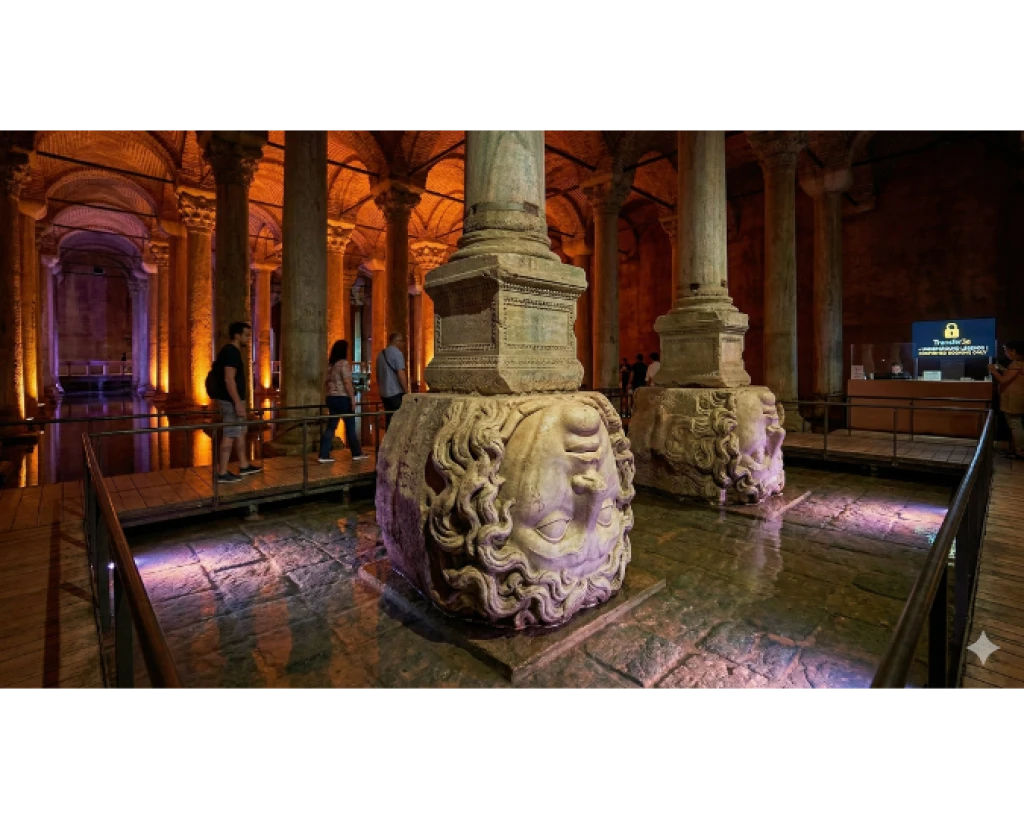
Sultanahmet has 3 Byzantine cisterns a short walk apart: the Basilica Cistern (Yerebatan Sarnıcı) with its forest of columns and Medusa heads, the smaller Theodosius Cistern (Şerefiye Sarnıcı) and the Binbirdirek Cistern, which hosts events. If you only see one, make it the Basilica Cistern, but note that it changed operator in June 2026, so check its current prices and evening hours at the entrance.
The Basilica Cistern: history and layout
Emperor Justinian I built the Basilica Cistern in the 6th century to store water for the city. It takes its name from the Stoa Basilica, a great public square that stood above it, and the Turkish name Yerebatan Sarayı means "underground palace". It is the largest of the several hundred ancient cisterns beneath Istanbul.
- 336 marble columns, each about 9 metres high, in 12 rows of 28. Most were reused from older buildings.
- About 138 by 65 metres, with room for about 80,000 cubic metres of water.
- Today you walk on a raised walkway above shallow water, in low light.
After the Ottoman conquest the cistern was largely forgotten, although people living above it still drew water from it. In the 16th century the French scholar Petrus Gyllius described being rowed between the columns and seeing fish swimming beneath his boat. It opened to the public in 1987, after tonnes of silt had been cleared out.
Medusa heads and the Hen's Eye column
In the northwest corner, 2 columns stand on carved blocks showing the face of Medusa, the Gorgon of Greek myth. One block lies on its side and the other is upside down. Nobody knows where they came from. They are thought to come from a late Roman building, and there is no evidence that they were carved as column bases.
Look also for the Hen's Eye column. It is carved with raised hen's eyes, slanted branches and tear shapes, a pattern that resembles the columns of the 4th-century Triumphal Arch of Theodosius I. Because of the tears, guides call it the "crying" or "weeping" column.
The 2022 restoration and art
The cistern closed in 2017 for restoration and earthquake strengthening and reopened in 2022. The work replaced old iron tie-rods with stainless-steel rods and removed 20th-century concrete walkways to reveal the original Byzantine brick floor. A separate steel walkway, LED lighting and sensors were added.
The reopening came with a contemporary art show, "Daha Derine" ("Going Deeper"), with works by Jennifer Steinkamp, Ozan Ünal, Aslı İrhan and Ali Abayoğlu that used projection, sculpture and light. Those works were temporary. Other light and art installations have appeared among the columns since, so what you see depends on when you visit.
Basilica Cistern tickets and hours in 2026
The Istanbul Metropolitan Municipality (İBB) ran the cistern until 2 June 2026, when, after a court ruling, its management passed to the General Directorate of Foundations (Vakıflar). The cistern closed for a few days and reopened on 6 June 2026. İBB's court challenge was reported as still pending in October 2026.
The new operator had not published a price list for foreign visitors that we could confirm in October 2026, so check the fee at the ticket office. For comparison, under İBB foreign visitors paid 1,950 TL for a day visit (09:00–18:30) and 3,000 TL for a separate evening session (19:30–22:00). Whether the evening session continues was also unconfirmed in October 2026.
- Come at opening time. The first half hour is the quietest, and midday is the busiest.
- Weekdays are calmer than weekends.
- Everyone goes through the same security check, even with a pre-booked ticket.
- The Museum Pass Istanbul is not valid here.
- Download any audio guide before you go down.
Theodosius and Binbirdirek cisterns
Theodosius Cistern (Şerefiye Sarnıcı). Built in 428–443 under Theodosius II to store water from the Valens Aqueduct, it measures about 40 by 20 metres and has 32 marble columns. It lay forgotten under later buildings until 2010, when the municipality demolished an annex above it, and it reopened in 2018 after restoration. A 360-degree projection system now plays shows across the columns. İBB's culture company Kültür AŞ runs it, and it is open every day. Foreign visitors pay an entrance fee; check the current amount and hours at the door. The entrance is on Piyer Loti Caddesi, near the Çemberlitaş tram stop.
Binbirdirek Cistern. The second-largest cistern in Istanbul has 224 columns, each about 14–15 metres tall. It dates from the 5th century and was restored under Justinian. Its name means "1,001 columns", a Turkish way of saying "very many". It lies between the Hippodrome and Çemberlitaş, at İmran Öktem Sokak 4, and hosts ticketed events such as whirling dervish ceremonies. We could not confirm regular opening hours or a fee for ordinary visits in October 2026, so check before you go.
| Cistern | Built | What you see | Entry in October 2026 |
|---|---|---|---|
| Basilica (Yerebatan) | 6th century, Justinian I | 336 columns, Medusa heads, changing art | New operator since June 2026; check the price at the gate |
| Theodosius (Şerefiye) | 428–443, Theodosius II | 32 columns, projection shows | Open daily; fee for foreign visitors at the door |
| Binbirdirek | 5th century, restored under Justinian | 224 tall columns | Ticketed events; check before you go |
The legends, told as legends
Dark water and old stones invite stories. These are the ones guides like to tell. Enjoy them as folklore, not history.
- Medusa's gaze. In Greek myth, anyone who met Medusa's eyes turned to stone. One story says the builders laid her heads sideways and upside down so that her gaze could do no harm. A more practical explanation is that they reused old blocks and set them at whatever angle gave the right height.
- The crying column. The tears on the Hen's Eye column are said to weep for the workers who died building the cistern. Old texts claim that 7,000 enslaved people worked on it, a figure nobody can check.
- Fish under the floor. The story goes that families living above the cistern lowered buckets through holes in their floors to draw water, and sometimes pulled up fish. Gyllius did write that he saw fish swimming between the columns.
Getting there from Sultanahmet hotels
The Basilica Cistern is about 150 metres southwest of Hagia Sophia, a few minutes' walk from the Sultanahmet stop on the T1 tram. From most hotels in Sultanahmet you will walk, since many streets are narrow or pedestrian. For the Theodosius Cistern, ride 1 stop west to Çemberlitaş or walk along Divan Yolu for about 10 minutes. Binbirdirek is in between, a few streets west of the Hippodrome.
Trams run from about 06:00 to midnight. A full İstanbulkart fare is 46.20 TL, and contactless bank cards also work on the tram. You can combine the cisterns with Hagia Sophia, the Blue Mosque and Topkapı: our Sultanahmet sights guide has a plan for the day, and our street food guide covers lunch.
Arriving by air? Our Istanbul Airport to Sultanahmet and Sabiha Gökçen to Sultanahmet transfers have a fixed price per vehicle, agreed when you book. The driver meets you with a name sign and stops at the drop-off point closest to your hotel.
Frequently asked questions
How much is the Basilica Cistern ticket?
After the change of operator in June 2026, we could not confirm the new price for foreign visitors, so check at the ticket office. Under the previous operator, a day ticket cost 1,950 TL and an evening ticket 3,000 TL.
Is the Basilica Cistern included in the Museum Pass Istanbul?
No. The pass covers state museums such as Topkapı Palace, and the cistern has never been part of it.
Are the Medusa heads real?
Yes, they are genuine ancient carvings, but they were not made for the cistern. They were reused as column bases, and the stories about why they lie sideways and upside down are legends.
How long should I allow?
Allow 30–45 minutes for the Basilica Cistern plus any queue, and about 30 minutes for the Theodosius Cistern.